Quebec National Assembly returns amid two leadership races, growing election uncertainty
Posted February 3, 2026 4:02 pm.
Last Updated February 3, 2026 5:29 pm.
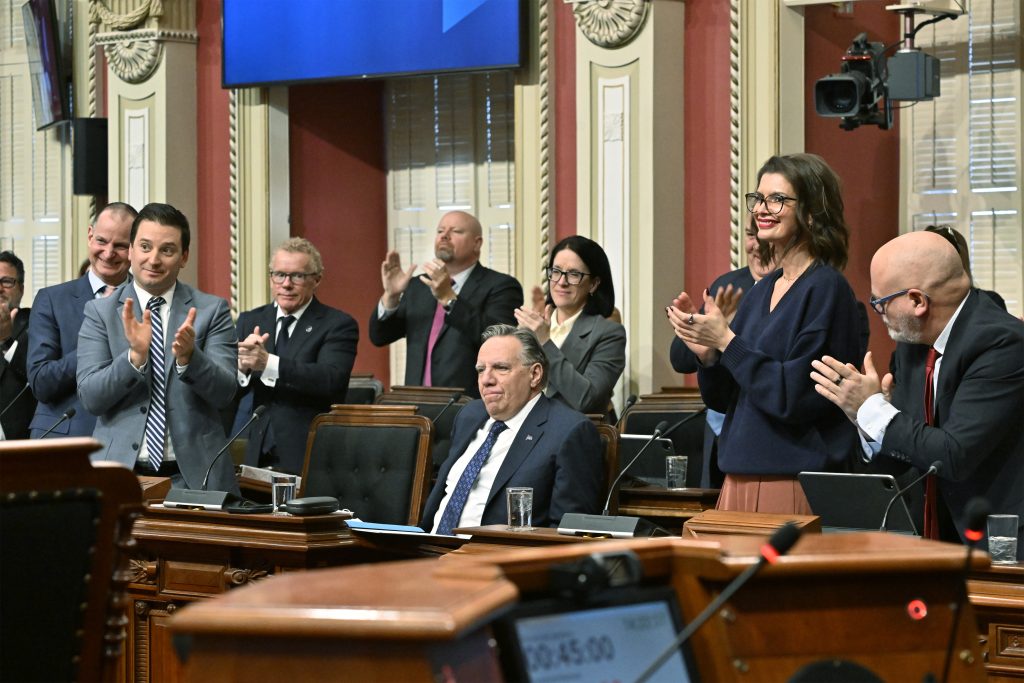
Quebec’s National Assembly resumed sitting Tuesday against a backdrop of political uncertainty, with two parties in leadership races and the provincial election approaching later this year.
The CAQ government and the Quebec Liberal Party (PLQ) are both looking for a new leader, while the Parti Québécois (PQ) continues to show strength in the polls. The shifting political landscape is shaping what parties say will be a pivotal legislative session ahead of the election campaign period.
Premier François Legault said he welcomed the return of debate in the legislature.
“I’m glad to see that we can have excellent debates,” Legault said Tuesday, speaking to reporters at the National Assembly.
“It is a very different session. First of all, there will be an election this year. It changes the dynamics. The premier has resigned,” added PQ Leader Paul St-Pierre Plamondon on the political dynamics having changed significantly compared with previous sessions.
Liberal interim leader Marc Tanguay said the upcoming election will hinge on the direction voters want Quebec to take.
“It’s going to be a debate between the Quebec Liberal Party under a new leadership and the Parti Québécois with its so-called separation,” he said.
Québec solidaire co-spokesperson Ruba Ghazal acknowledged the party faces challenges heading into the campaign but said it has overcome difficulties before.
“It’s not where we would have liked to be, but we’ve seen other situations,” she said.
Months ahead could reshape race: political analyst
“Right now, the PQ is in a good position. However, with all this leadership race going on, they have become the new target,” said Daniel Tran, director of communications and governmental affairs at consultancy firm Casacom.
Tran added the PQ currently benefits from political instability elsewhere. “If that leadership race distracts the attention of the real issues, that could also be a problem,” he said.
Public opinion remains mixed as voters look ahead to the election.
Montrealer Joelle Ferland said she is leaning toward voting Liberal but is not enthusiastic about the choice. “Not CAQ, not Parti Québécois, probably Liberals. But I’m not excited about it.”
“It’s just going to be four more years of what we’ve had in the past 60 years of my life. So I guess we’ll just move ahead and hope for the best,” said Nick Fiore who plans to vote for the Libs. Fiore believes most French-speaking Quebecers will split their votes between the CAQ and PQ, something he hopes gives the PLQ a chance of getting a minority government.
Another Montreal, Salma Alami, said she hopes a new political era begins in Quebec: “I’m delighted by the idea of renewal.”
Much of the attention at the legislature this week centred on the governing CAQ, which is preparing to choose a new leader April 12 following Legault’s resignation.
Some opposition figures questioned whether the National Assembly should have delayed its return until the party selects a successor, arguing accountability is unclear while leadership is in transition.
St-Pierre Plamondon noted 17 CAQ members have announced departures from politics, while Tanguay argued the government is nearing the end of its mandate after multiple high-profile exits.
“Many others left this bad government. It’s the end of the road for the CAQ government,” said Tanguay.
Québec solidaire co-spokesperson Sol Zanetti suggested the government should pause major initiatives until a new leader is in place.
Public reaction to the government’s record remains divided. Some voters expressed anger with the party’s performance, while others credited the government’s handling of the pandemic but said progress has slowed since.
“I hate them, so I really wish they don’t win and I don’t think they will, because people are really fed up with everything that happened,” said Ferland.
“I think that the actual government did a good job during the pandemic, but so far in the last four years we haven’t seen many other things advance,” said Marcus Fraga.
When asked who he would vote for, Fraga said he aligns with much of the PQ’s politics. But in order to get his vote, he wants the party to redirect their attention to issues that he says unite people rather than divide them.
Meanwhile, the Quebec Liberal Party is also managing internal tensions as its own leadership race continues, with a new leader expected to be chosen March 14.
Former Liberal parliamentary leader Marwah Rizqy returned to the National Assembly Tuesday, sitting as an Independent, after having been expelled from the Liberal caucus. Rizqy told reporters she still considers herself a Liberal and stands by decisions she says she was compelled to make.
“I asked for absolutely nothing. I didn’t even ask for my expulsion, but that becomes their prerogative,” Rizqy said.
Tanguay said whether Rizqy eventually returns to the Liberal caucus will be decided by the party’s next leader in consultation with caucus members.
Tran said a leadership change could allow the party to move beyond recent controversies and reset its public image ahead of the campaign.