Closures of private seniors residences in Quebec: ‘We are in the midst of a crisis’
Posted February 19, 2026 8:25 am.
Last Updated February 19, 2026 4:42 pm.
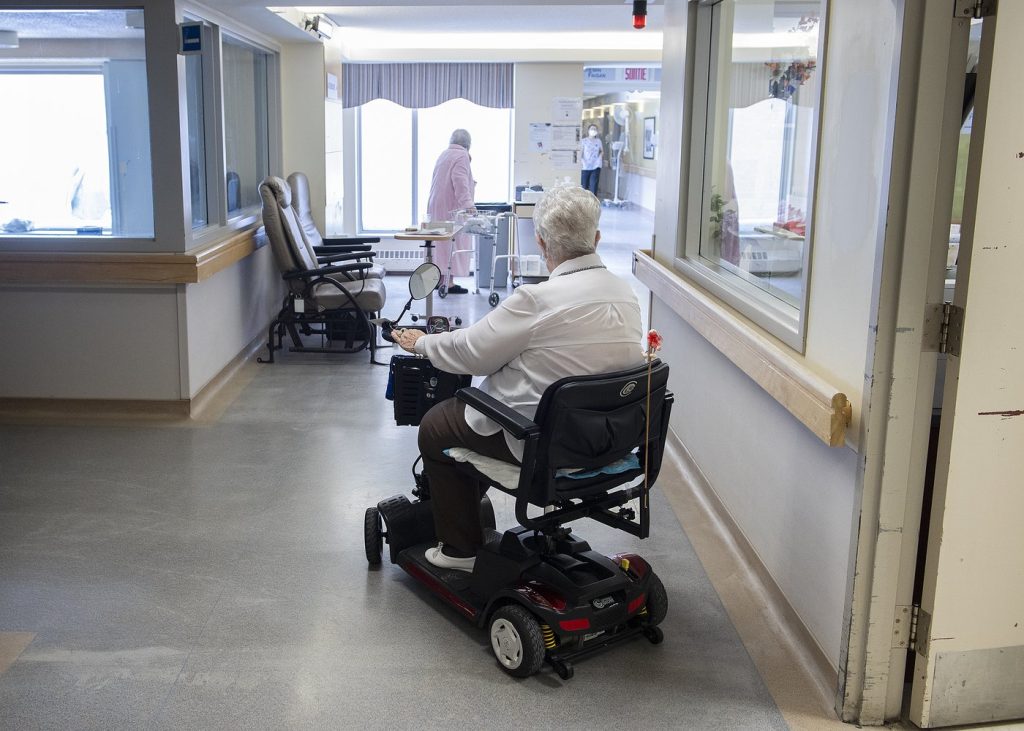
The closures of private seniors residences (RPA) continue in Quebec. The Regroupement québécois des résidences pour aînés (RQRA) is raising a red flag about the funding of care in these living environments for seniors.
In eight years, 740 private seniors homes have closed. Over the past year, the pace of closures has slowed somewhat, but on average, one RPA per week is still closing its doors. There are currently about 1,350 still open.
When a private seniors residence announces its closure, residents’ choices are limited, as the waiting list for a place in a long-term care facility (CHSLD) is just under 3,500 people, and about 5,000 people for intermediate resources (RI). Many people end up in a hospital room waiting for a place to become available.
“We are trying to work with Santé Québec on measures to reduce transfers to hospitals because, obviously, people should not be hospitalized if they don’t need to be. We need places for people who really need them. So we end up with people who are hospitalized because there is no room in CHSLDs, no room in seniors’ homes, and no room in IRs,” laments Marc Fortin, president and CEO of the RQRA.
What’s more, two out of three seniors living in these homes say they don’t have enough money to pay for the care they receive. “Because of their conditions, because of their loss of autonomy,” explained Hans Brouillette, the director of government and public affairs at the RQRA.
The RQRA says private seniors’ homes risk collapsing as seniors become more and more unable to cover their costs.
“We are facing a tsunami of needs because of the aging (of the) population,” Brouillette said.
According to Fortin, the government does not provide sufficient funding for care in RPAs. The results of a Léger poll published on Thursday reveal that nearly eight out of ten RPA owners say that the amounts paid by CISSSs and CIUSSSs do not cover the actual costs of care and services provided to residents. It should be noted that the majority of RPAs are for-profit, but not all.
“We save the government nearly $4 billion a year for the 38,000 dependent people in our network. Four billion is the net amount after other programs and home care that the government pays for these people because it doesn’t pay the RPA, it pays an allowance to provide care for the person,” Fortin explained in an interview.
“We save a lot of money, but unfortunately, it’s at the expense of RPA owners,” he said.
“I know that there are many cuts now in CISSS and CIUSSS,” added Brouillette. “They try to balance the budget, but we cannot escape from the real needs seniors have in terms of assistance, care, and nursing care.
The amounts allocated to RPAs to provide care vary, with the lowest rate being $21 per hour, Fortin said. “When you’re paid $21, $28, or $32 an hour, you’re providing care at a loss. That’s why many RPAs have simply stopped providing care, moving from category 4 to category 3 or category 2. […] There is no one, absolutely no one, with a care worker as the main caregiver who can provide an hour of care for less than $39 or $40 an hour. It’s impossible.”
Most RPAs are intended for seniors with a more pronounced loss of independence, i.e., category 3 or 4. Category 1 and 2 RPAs are intended for independent seniors.
Fortin urges decision-makers to resolve this funding issue. “We must stop taking advantage of RPA owners when it comes to the care that people need, and we must pay them appropriately,” he argues.
The RQRA is now urging the government to speed up the rollout of its already existing funding model that was announced in 2024 – a $200-million program that would give out monthly allowances to seniors in RPAs.
“The money has to come in one way or another,” said Brouillette.
The Léger survey was conducted among 453 residents and 91 managers of RPAs located in Montérégie and Lanaudière. Data was collected in the summer and fall of 2025. The margin of error is plus or minus 4.6 per cent for residents and plus or minus 10.3 per cent for managers, 19 times out of 20.
When seniors were asked who provides the care they receive, 84 per cent responded that it was the residence staff, whereas on paper, a larger proportion should be the responsibility of the CLSC.
The survey mentions that among those who receive care from the CISSS/CLSC (34 per cent of respondents), one-third report that the person responsible for their care has failed to show up for a scheduled appointment. Most report that they simply did nothing, mainly because they did not know what to do.
This includes care and services such as bathing, administering medication, or lifting, Fortin explains. “Often, we are forced to do it for free because the people from the CISSS or CLSC don’t show up,” he says.
According to him, labour shortages and health care budget cuts are partly to blame. Fortin is asking to sit down with Santé Québec, the Ministry of Health, and all the players involved in caring for seniors in Quebec, including the Réseau de coopération des EÉSAD and the rest of the Regroupement québécois des résidences pour aînés, a coalition of six major senior housing associations created in 2025.
“Everyone needs to sit down together and work on finding a solution. A tidal wave is coming, a wall is coming down on us with Quebec’s seniors in the next few years, and we’re not ready,” says Fortin. We are in a crisis, we have both feet in the crisis. We need to take action now because the price of inaction will be so high in the next three to five years. We have to do it now.”
Montreal geriatrician Dr. Donald Doell says the recent numbers aren’t anything new.
“The cost of things are going up, and certainly that applies to care as well,” said Doell, who works at the Montreal General Hospital.
Doell says as seniors age, their care needs often grow, and each added layer of care comes with an extra cost.
“When they move into an RPA or a residence and need a certain amount of help, that help that they need might increase as they become more disabled,” the Montreal doctor said.
He warns when seniors can no longer afford to stay in private residences, the strain shifts to the public system.
“We have people winding up in hospital without places to go, where there’s already a shortage of beds.
“So this issue is important to recognize and it has these downstream effects.”
–With files from La Presse Canadienne